


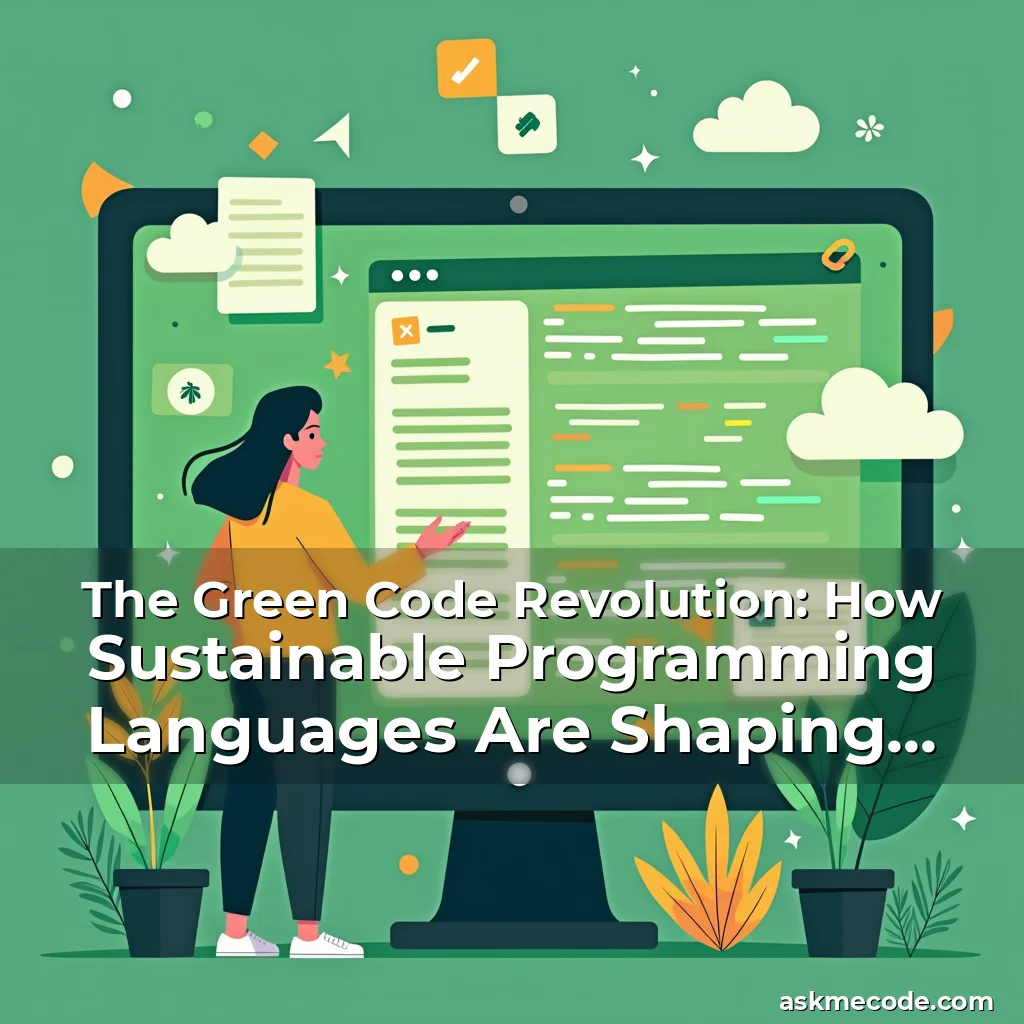
The Green Code Revolution: How Sustainable Programming Languages Are Shaping Eco-Friendly Tech
In an era where environmental consciousness is reshaping every industry, the world of software development is undergoing its own green transformation. The rise of sustainable programming languages offers a compelling intersection between technology and ecology.
This article explores how these specialized coding tools are not only reducing carbon footprints but also empowering developers to create solutions that align with our planet’s needs.
Eco-Conscious Foundations of Modern Programming
Sustainable programming languages are built from principles that prioritize energy efficiency at their core. Developers can now choose languages optimized for low power consumption without sacrificing performance capabilities.
These languages often feature lightweight syntax structures that require fewer computational resources during execution. This reduction in processing demands translates directly to lower energy usage across global server networks.
For example, Rust has emerged as a leader in memory safety while maintaining high performance levels through its ownership model. This approach minimizes runtime overhead compared to traditional garbage-collected languages.
- Memory Efficiency: Smart resource management reduces unnecessary allocations
- CPU Optimization: Compilers generate highly efficient machine code
- Scalability: Designed for both small devices and large distributed systems
The Carbon Footprint of Software Development
Digital infrastructure contributes significantly to global greenhouse gas emissions, with data centers alone accounting for nearly 2% of total electricity use worldwide.
Programming choices directly impact this footprint through factors like algorithm complexity, data storage requirements, and network communication patterns.
A study by the Shift Project found that training a single AI model could emit up to 58 tons of CO₂e – equivalent to driving a car around the globe over five times.
By selecting appropriate languages, developers can reduce computational intensity and optimize resource utilization across entire application ecosystems.
Green Language Innovations in Action
Several programming languages have pioneered sustainability-focused features tailored for modern ecological challenges. These innovations address everything from energy conservation to waste reduction in digital processes.
TypeScript extends JavaScript with static typing while maintaining compatibility with existing web frameworks. Its enhanced type checking reduces debugging time and prevents inefficient runtime errors.
Kotlin offers interoperability with Java while providing more concise syntax that leads to cleaner, more maintainable codebases requiring less processing power.
- Code Quality: Better type systems catch issues early in development
- Maintainability: Clearer syntax improves long-term project viability
- Interoperability: Enables reuse of legacy systems with minimal overhead
Energy-Efficient Algorithm Design
Beyond language choice itself, sustainable programming emphasizes algorithmic efficiency as a critical factor in minimizing environmental impact.
Developers must consider Big O notation when designing algorithms, prioritizing linear-time operations over exponential ones whenever possible.
Efficient sorting techniques like Timsort offer optimal performance across diverse dataset types while using minimal additional memory.
Data structure selection plays an equally vital role in determining overall system efficiency and energy consumption patterns.
Power Consumption Metrics in Practice
Measuring the real-world energy implications of different programming approaches requires careful benchmarking against standardized metrics.
Tools like the JouleMeter framework allow developers to quantify energy usage during various stages of application execution.
Comparative studies show Python programs consume approximately 20% more energy than equivalent C++ implementations under similar workloads.
However, Python’s simplicity and extensive libraries make it a popular choice despite these trade-offs in energy efficiency.
Sustainable Web Development Practices
Front-end development presents unique opportunities for integrating eco-conscious practices within web technologies.
Using CSS Grid instead of complex JavaScript layouts can drastically reduce client-side computation requirements.
Progressive enhancement strategies ensure basic functionality works even on older browsers with limited processing power.
Implementing lazy loading techniques delays non-critical resource downloads until they’re actually needed by users.
Cloud-Native Sustainability Solutions
Modern cloud computing platforms provide powerful tools for creating environmentally responsible applications at scale.
Serverless architectures minimize idle compute capacity by executing functions only when needed rather than running continuous services.
Containerization technologies like Docker enable precise control over resource allocation for individual microservices components.
Kubernetes orchestration optimizes cluster utilization by dynamically balancing workloads across available nodes.
Open Source Contributions to Green Computing
The open source community has become a key driver in advancing sustainable software development practices globally.
Projects like the Linux Foundation’s OpenChain initiative promote standardization of compliance processes that reduce redundant documentation efforts.
GitHub’s Sustainability Dashboard helps organizations measure and improve their environmental impact through code contributions.
Collaborative platforms foster knowledge sharing about best practices in energy-efficient development methodologies.
Future Directions in Green Programming
Ongoing research continues to push the boundaries of what’s possible in sustainable software engineering. Emerging trends suggest exciting new possibilities for eco-friendly development.
Quantum computing promises revolutionary advances in solving optimization problems with unprecedented efficiency.
Neural architecture search techniques may soon automate the discovery of energy-optimal deep learning models.
Advancements in hardware-software co-design will likely lead to more integrated solutions for reducing overall system energy consumption.
Conclusion
The evolution of sustainable programming languages represents a crucial step toward harmonizing technological progress with planetary health.
As eco-conscious developers continue exploring these options, we’ll see increasing adoption of green coding practices across industries and applications.
Choosing the right programming language isn’t just about technical capability anymore – it’s becoming an essential decision for building a more sustainable future.
By embracing these innovative approaches, developers play a pivotal role in shaping tomorrow’s eco-friendly digital landscape.


news is a contributor at AskMeCode. We are committed to providing well-researched, accurate, and valuable content to our readers.
You May Also Like

Database Management vs Alternatives: Complete Comparison
Database Management vs Alternatives: A Sustainable Living Perspective In an era where data drives decisions across industries, understanding database management...
Meet Typeform
Building a beautiful, usable form can be tricky. And building one that's accessible to everyone is even trickier. But you...
Git and Github Cheat Sheet for Visual Studio Code
Git and Github Cheat Sheet for Visual Studio Code: A blog about other code editors available and why code editors...
Tutorial Code Simplicity With VS code
There are many ways to achieve simplicity in software development, but none more powerful than keeping things as simple as...